
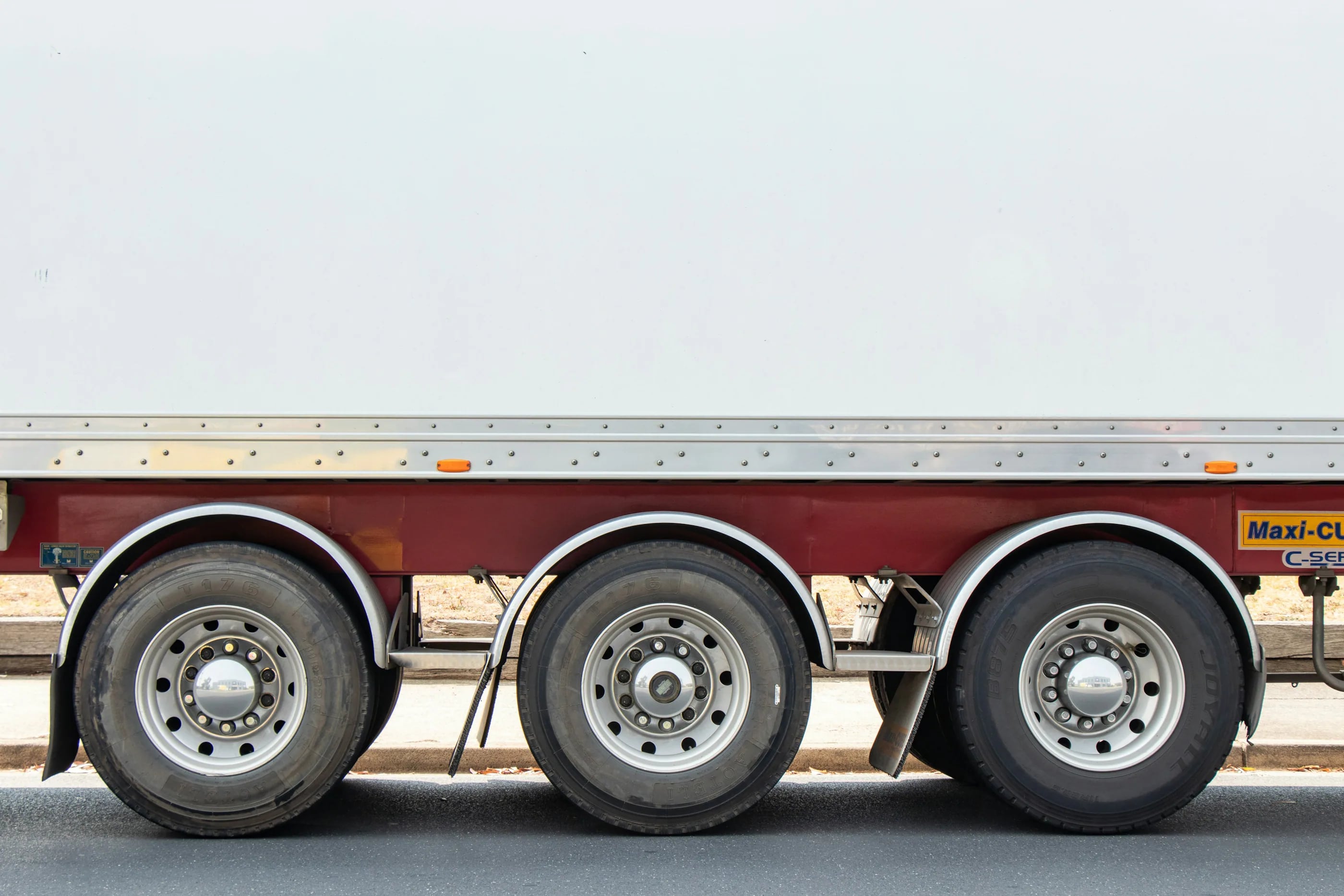
Trailer axles look like a catalogue purchase and are not. The same nominal rating covers products that behave very differently in service, and the difference shows up as bearing life, brake wear and tyre wear rather than as anything visible on delivery. Three figures determine almost the whole specification, and once they are fixed most of the remaining choices follow.
One: rating per axle, and the duty behind it
Rating is not simply payload divided by the number of axles. It has to account for how the load actually distributes, what happens under braking and cornering, and the road surface the trailer works on. A 13-tonne axle under a highway curtain-side and a 13-tonne axle under a tipper working site roads are being asked for different things, and specifying by the number alone gets one of them wrong.
So state the trailer type and the duty cycle alongside the rating: on-highway, mixed, or off-road. It is the single most useful qualifier on an axle enquiry.
Two: track width and the required ride height
Track width has to match the trailer's frame, the intended wheel and tyre package, and the legal width in the market it operates in. Ride height then follows from the deck height you need and the suspension you choose. Getting these wrong is not a performance problem, it is a fitment problem, and fitment problems are discovered after delivery.
If the trailer is being built to an existing design, send the drawing. If it is a new build, send the deck height, the frame dimensions and the wheel package you intend to use.
Three: suspension type
Mechanical leaf or air, and this decision reaches further than the suspension itself.
- Mechanical leaf — simpler, cheaper, more tolerant of poor maintenance and rough surfaces, and easier to repair with locally available parts. Still the right answer for a great many operations.
- Air — better ride quality and load protection, ride-height control, easier coupling at a fixed dock height, and lower dynamic loading into the frame. Requires an air system, and requires maintenance that is actually carried out.
The deciding factor is usually not the cargo. It is whether the operation has the maintenance capability and the parts access to keep an air system healthy. An air suspension that is not maintained performs worse than a leaf spring that is.
What follows once those three are fixed
- Braking — drum or disc, and whether ABS or EBS is required in your market and for your configuration
- Wheels — rim size, PCD and offset, which have to agree with both the hub and the tyre
- Tyres — size and construction, matched to the axle rating and the duty cycle rather than to the rim alone
- Hubs, bearings and seals — the parts that will define your service interval
- Landing legs, kingpin and fifth-wheel compatibility on a semi-trailer, which have to match the tractor unit, not just the trailer
- Lighting, mudguards and marking to the destination market's requirements
The coupling interface deserves its own check
On a semi-trailer, kingpin size and fifth-wheel compatibility are decided by the tractor units that will actually pull it — including the ones the operator might add later. A mixed fleet with two different coupling standards is a problem that gets more expensive every year it goes unaddressed, and it is trivially avoidable at specification time.
What to send with an axle enquiry
- 01Trailer type — flatbed, container, low-bed, tipper, tanker, box or curtain-side
- 02Number of axles and the rating required per axle
- 03Track width, and the ride height the deck height implies
- 04Suspension: mechanical leaf or air
- 05Braking: drum or disc, with or without ABS or EBS
- 06Wheel and tyre package, with PCD and offset if already fixed
- 07Kingpin size and fifth-wheel standard, for semi-trailers
- 08Quantity for this order and expected annual volume
That is enough to quote from without a second round of questions. If some of it is not decided yet, say which — a specification conversation is a perfectly good starting point, and it is a much better one than a rating with nothing attached to it.